 Tailwatch
Track a plane by tail number, with takeoff and landing alerts
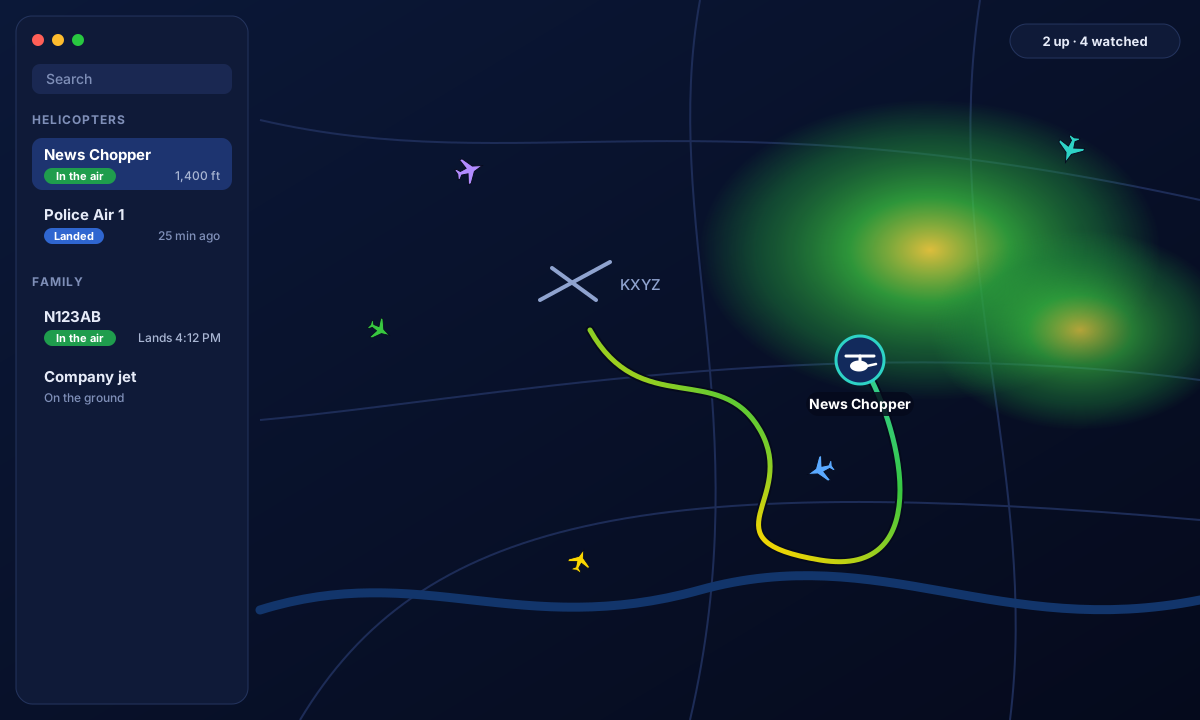
If you follow one particular aircraft, such as a family member's plane, a company aircraft or a flying club's trainer, you don't want to keep refreshing a website. You want to be told when it moves.
What a tail number is
Every aircraft has a registration painted on it, often called a tail number. In the US it starts with N, like N123AB. Other countries use their own prefixes, like G- in the UK or C- in Canada. It identifies one specific airframe, whatever flight it happens to be flying.
That makes it different from an airline flight number, which names a route and is flown by a different aircraft each day. Tailwatch can follow either one.
Add the aircraft
- Choose File → New Aircraft… (⌘N).
- Choose Tail number and type it.
- Name it and click Add.
If the aircraft is parked with its transponder off, it shows "Not seen". Nothing is wrong. Tailwatch keeps checking and tells you when it appears.
Turn on the alerts you want
- Takeoff: when it leaves the ground.
- Arrival: shortly before it reaches its destination.
- Landing: when it is down, once per flight.
- Emergency: if it squawks an emergency code.
Quiet hours keep overnight flights from waking you.
Where is it going?
Private flights don't publish a destination, so Tailwatch works it out. For airline-style callsigns it looks up the scheduled route. For everything else, once the aircraft is descending it estimates the likely airport. You can also set the destination yourself for one flight if you know it.
See the flight afterwards
Each flight goes into the aircraft's flight log on your Mac: when it left, where it went, and its path. If Tailwatch first sees the aircraft already in the air, clicking it loads the earlier part of the flight when the data source has it.
When a tail number doesn't show up
- It isn't broadcasting. Some older aircraft have no ADS-B, and aircraft on the ground often switch it off.
- It's out of coverage. Public data depends on volunteer receivers. Coverage is thin over oceans, mountains and remote areas, and at low altitude.
- It uses a privacy program. Some US owners use rotating identifiers (PIA), which hide the tail number in the broadcast itself. Those aircraft usually can't be followed by tail number in any tracker.
- The number is slightly off. Check for a letter O typed as a zero, or a missing prefix.
How quickly you'll hear
With no setup, Tailwatch checks through adsb.lol's free tier, which means an update every few minutes. A free key roughly doubles that. If the aircraft is based near you, your own receiver catches takeoffs within seconds. See Data sources and limits.